VR Attraction Trends 2026: What Operators Are Buying and Why


In 2026, FEC and mall operators are buying VR attractions built around three shifts: falling headset hardware costs that shorten payback periods, unattended and cashless operation that cuts labour dependency, and multiplayer or independent-seat formats that raise throughput on a fixed footprint. Meanwhile, tightening safety and labelling regulation in major markets is raising the bar for documentation buyers should expect from any manufacturer. This article breaks down what’s actually changed and what it means for a purchasing decision made this year.
Trend 1: Falling Hardware Costs Are Shortening Payback Periods
Standalone VR headset prices have dropped sharply as chipset commoditisation and lens manufacturing scale improve, with consumer-grade headsets that cost well over a thousand dollars just a couple of years ago now available at a fraction of that price during promotional periods. For commercial venues, this has a direct effect: break-even timelines for high-footfall installations have compressed meaningfully compared to just a couple of years earlier, because hardware cost is a smaller share of total investment than it used to be.
The practical takeaway for operators: a payback model built on 2023 or 2024 hardware-cost assumptions is now out of date. Rerunning the throughput and ROI math described in our VR attraction ROI guide with current hardware pricing typically produces a faster payback estimate than older industry benchmarks suggest.
Trend 2: The “Novelty Era” Is Over — Genuine Differentiation Now Wins
Industry observers increasingly describe 2026 as the point where VR stopped being a novelty that sold itself simply by existing. Early adopters have already seen a standard VR headset experience; what draws repeat visits and word-of-mouth now is a genuinely differentiated physical sensation — strong motion, real environmental effects, multiplayer interaction — rather than VR content alone. This is part of why full-motion attractions with a visible physical footprint, rather than seated single-player cabinets running generic content, are taking a larger share of new FEC investment.
Trend 3: Unattended and Cashless Operation Is Becoming the Default
Labour cost has consistently been one of the biggest constraints on FEC and arcade profitability, and 2026 has seen a clear shift toward VR machines designed to run with minimal staff supervision. Coin, card, and QR/mobile payment support on a single machine — combined with backend dashboards for remote fault monitoring and revenue auditing — has moved from a premium feature to close to a baseline expectation for new equipment purchases. Operators evaluating a new machine increasingly ask about unattended capability as a standard part of the buying process, not an optional add-on. Our guide to operating a VR ride unattended covers what this actually requires in practice.
Trend 4: Multiplayer and Independent-Seat Formats Are Gaining Share
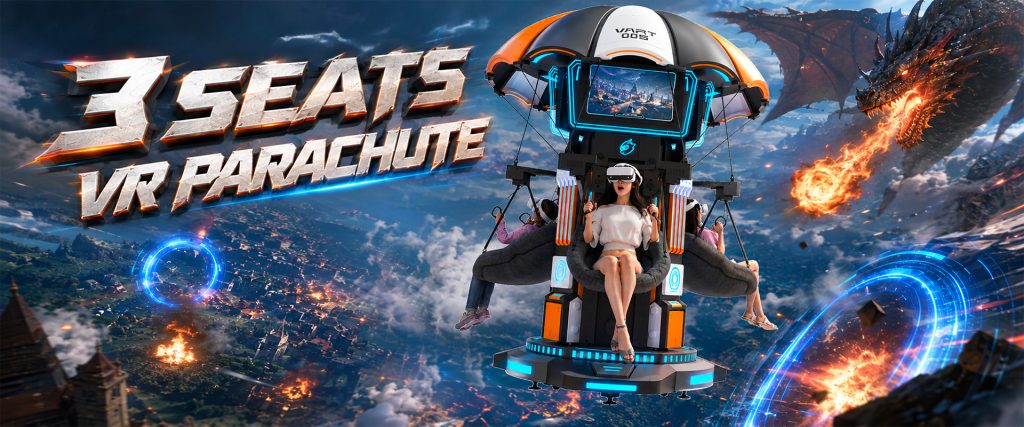
Free-roam and multiplayer VR formats are among the fastest-growing segments of the location-based entertainment market, reflecting a broader shift toward social, shared experiences rather than isolated single-player sessions. This mirrors what’s happening at the equipment level: multi-seat rides with independently operated stations — where one rider can be served without waiting for a full group cycle — are increasingly favoured over banks of separate single-rider cabinets, because they solve queue-management problems that single-rider setups can’t. This is covered in detail in our 3-seat multiplayer throughput guide.
Trend 5: Regulatory and Safety Documentation Requirements Are Tightening
Compliance expectations for commercial VR and arcade equipment are rising in major markets. Updated safety standards for commercial electronic amusement equipment are taking effect in the European Union in 2026, and updated warning-label requirements for arcade and VR equipment are being introduced in the United States around the same period. For buyers, this means the certification and documentation questions covered in our manufacturer due-diligence guide are becoming more important, not less — a machine that can’t produce current compliance documentation is a bigger liability in 2026 than it would have been a few years ago.
Trend 6: Asia-Pacific Continues to Lead Installation Growth
Asia-Pacific remains the largest regional market for location-based VR by installed base, driven by dense urban entertainment districts, rising disposable income, and strong tourism-linked demand across major cities. North America and the Middle East are seeing some of the fastest growth rates off a smaller base, as mixed-use retail and tourism developments increasingly treat a VR attraction as a standard anchor tenant rather than an experimental add-on.
What This Means for a 2026 Purchase
| Trend | What to Look For When Buying |
|---|---|
| Falling hardware costs | Re-run your ROI model with current pricing rather than relying on older benchmarks |
| Novelty era ending | Prioritise genuine motion and sensory differentiation over headset specs alone |
| Unattended operation as default | Confirm multi-payment support and backend dashboard access are included, not an add-on |
| Multiplayer / independent seats | Compare shared-queue throughput against single-rider alternatives before choosing a format |
| Tightening regulation | Request current safety certification and documentation as a standard part of any quote |
| Asia-Pacific leadership | Sourcing directly from an established regional manufacturer can shorten lead times and support costs |
Frequently Asked Questions
Why are VR attraction payback periods shortening in 2026?
Standalone VR headset prices have fallen substantially due to chipset commoditisation and manufacturing scale, reducing the hardware share of total investment and compressing break-even timelines compared to just a couple of years ago.
Is single-player VR still a good investment in 2026?
It can be for venues prioritising content variety, but industry demand is shifting toward multiplayer and independently-operated multi-seat formats, which generally deliver higher throughput per square metre on busy floors.
What should I ask about safety compliance before buying VR equipment in 2026?
Ask for current safety certification and documentation relevant to your destination market, since safety and labelling requirements for commercial VR and arcade equipment are tightening in major markets including the EU and the US during 2026.
Is unattended operation now expected for new VR machines?
It’s increasingly treated as a standard requirement rather than a premium feature. Multi-payment support and remote backend monitoring have become close to a baseline expectation in new equipment purchases.
Which region is buying the most VR attractions in 2026?
Asia-Pacific remains the largest market by installed base, while North America and the Middle East are among the fastest-growing regions as VR attractions become standard anchors in mixed-use retail and tourism developments.
Next Steps
See how VART’s VR Sky Glider and VR Parachute Simulator are built around these 2026 buying priorities — unattended operation, multiplayer throughput, and current safety certification — or start with our full VR Flight Attractions Buyer’s Guide before you contact us for a quotation.