5D vs 7D vs 9D vs 10D Simulator Cinema: What’s the Real Difference? (2026 Buyer’s Guide)

When you have spent any time looking into what a motion cinema attraction would do in your venue, you have likely noticed an issue: no one appears to have a consensus on the definitions of what 5D, 7D, 9D, or 10D means. The setup of one supplier resembles that of another supplier: same seats, same screen, same effects, a different number stapled on the marketing page.
It is no coincidence. No industry standard organization governs these terms as there is for IMAX or 4DX. The count of manufacturers sets its own version of the D count, as two different venues can install almost the same hardware and name it by a different name. To a buyer comparing quotes, that is a genuine problem: you compare labels rather than specifications.
This guide cuts through the labeling confusion and breaks down what each tier of D actually brings to it so that you can judge a 9D Simulator Cinema, a Commercial 7D Simulator Cinema or a 5D Simulator Cinema by what hardware and experience it brings, rather than on marketing shorthand.
Why “XD Cinema” Terminology Gets Confusing
All the motion cinema formats are based on the same principle: a 3D or a 4K movie that is projected to the screen before riders are seated. There, manufacturers add another layer of motion, environmental effects, sensory extras, and every extra layer is counted as an extra D.
The problem is that there is no standard definition of what a dimension is. A single manufacturer may consider wind and water spray two different D’s. Alternatively, some may include all the effects of the environment in a single D and instead count the axes of seat movement individually. The consequence is that more of one factory can imply less movement and fewer effects compared to less of another.
The solution is not to debate the nomenclature, but to look beyond the name altogether and consider four tangible items: motion axes (degrees of freedom), environmental impact, display technology, and seat/cabin engineering. Those four considerations inform you of what you are in fact purchasing, no matter what the number on the brochure is.
What Each “D” Actually Adds
The Base Layer: 3D/4K Visuals
All simulator cinema levels begin here: a big screen or curved screen with pre-created film content, usually 8 to 12 minutes per session. This is the base, not a distinguishing factor.
Motion Platform DOF (Degrees of Freedom)
This is the most common place of origin of D. The simplest of entry-level units normally operates on 2 to 3 axes: pitch and roll, occasionally vibration. A middle-range format typically provides yaw and heave, providing four to six synchronized axes of motion. The next levels introduce more sophisticated motion pictures: the simulation of weightlessness, the effect of acceleration/deceleration, and the jump or bank maneuvers, which are synchronized with the plot of the movie.
Environmental Special Effects
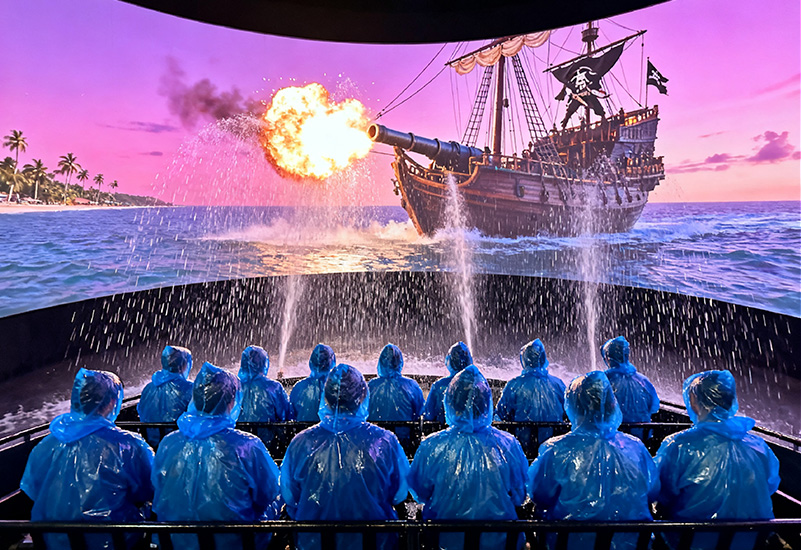
Sensory layer added on top of motion is wind, water spray, mist, snowflakes, bubbles, and lightning flashes. These may be two or three of these at entry-level levels. Immersive Cinema versions of higher levels add five, six, or more wind and water spray, leg-tickers, structural impacts, and lightning, all activated in response to the film.
Seat Vibration, Scent, and Tactile Extras
Certain formats incorporate localized seat vibration, air blasts at the height of the ankle (“leg-tickers”), or back-of-seat hits to on-screen impacts. Some types of scent dispensers are available, but less frequently found in commercial applications because of maintenance overhead.
Screen Curvature and Display Technology
This is the distinguishing factor that is of the greatest importance to the highest tier. In standard formats, the screen is flat or slightly curved, and frequently 3D glasses are necessary. The high-end segment, sometimes sold as naked-eye 10D, features a 180°-270° curved screen, optical blending, and a glasses-free 4K panorama display, eliminating the need to use eyewear at all.
5D vs 7D vs 9D vs 10D: Side-by-Side Comparison
| Feature | 5D | 7D | 9D | 10D (Naked-Eye) |
| Typical seat count | 4–9 | 6–12 | 12–30 | 12–40 (up to 100 multi-cabin) |
| Motion axes | 2–3 | 4–6 | 5–7 + weightlessness | 5–7 + weightlessness, diving, acceleration |
| Visual system | 3D glasses, flat screen | 3D glasses, flat/curved screen | 3D glasses or glasses-free, curved screen | Glasses-free 4K, 180°–270° curved screen |
| Environmental FX | 2–3 effects | 3–4 effects | 4–5 effects | 5+ effects (wind, lightning, snow, bubbles, spray, mist, impacts) |
| Typical footprint | 15–25 sqm | 20–35 sqm | 30–45 sqm | 35–48 sqm (30-seat standard) |
| Price tier | Entry-level | Mid-tier | Mid-to-premium | Premium |
| Best-fit venue | Small FEC, arcade corner | Mall FEC, mid-size attraction | Theme park anchor, mall FEC | Theme park anchor, scenic spot, flagship mall attraction |
Remember, they are different depending on the manufacturer; always request the exact DOF count and a list of effects instead of just the “D” number.
Naked-Eye 10D: The Emerging Premium Category
The most significant division in this market currently is not between 7D and 9D but between headset-based formats and naked-eye 10D formats. Taking away 3D glasses or VR headsets would address two operational nightmares simultaneously: you do not have to sanitize between riders, and there is no unit hardware to replace when guests lose or break eyewear.
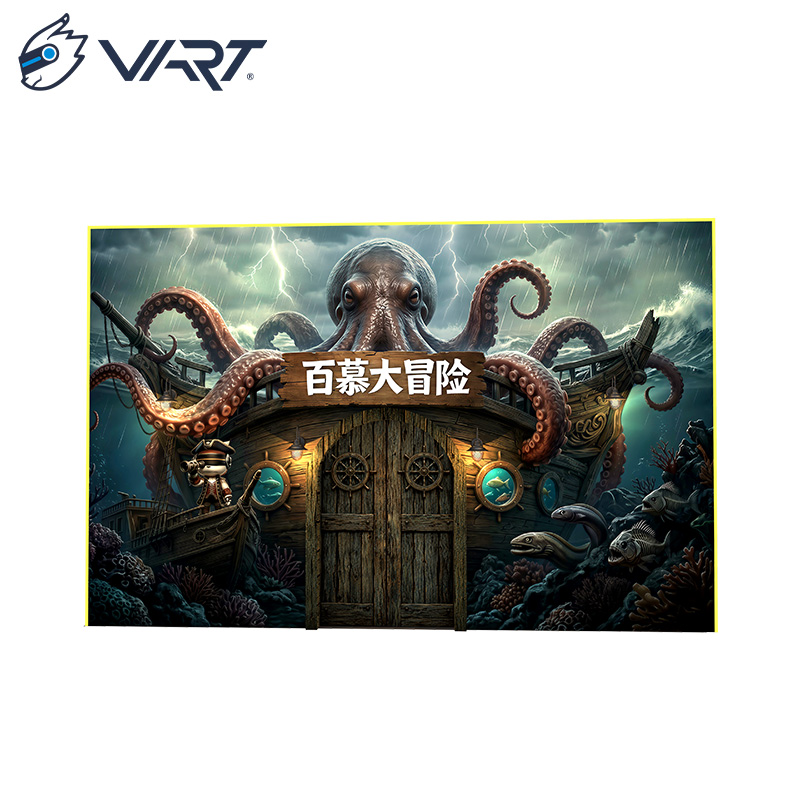
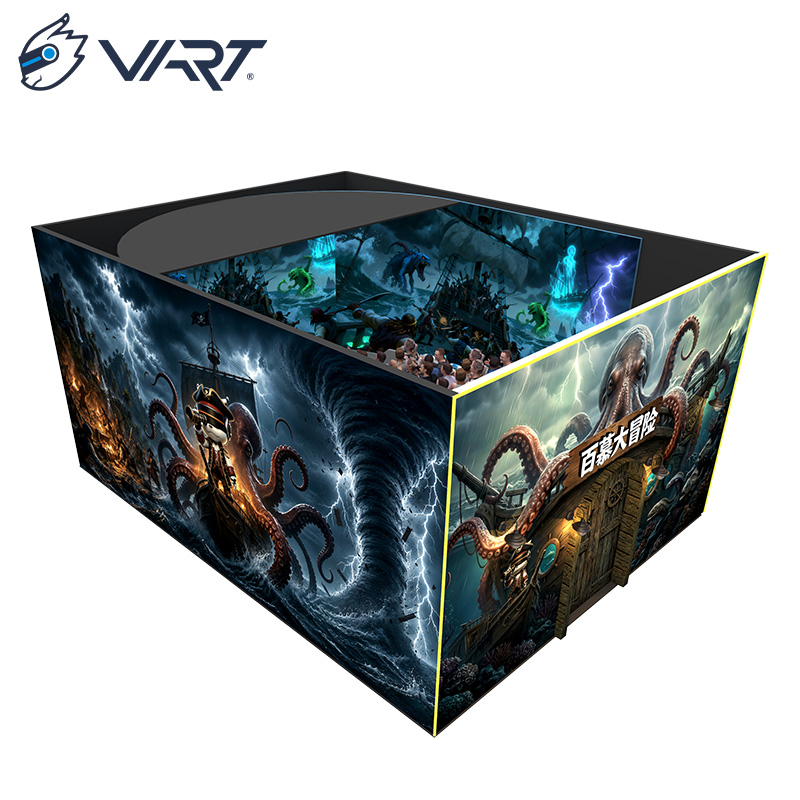
An example of this type is the Bermuda Storm Theater at VART. It operates a 4K fully panoramic display without glasses on a curved screen, coupled with a motion cabin with multi-degree-of-freedom motion and a full environmental FX stack of wind, lightning, snow, bubbles, water spray, mist, leg-tickers, and structure impacts.
Capacity ranges between 12 and 40 seats per cabin (with multi-cabin constructions up to 100 riders), and the typical 30-seat design is fitted within 35 to 48 square meters. The sessions are 8-12 minutes long, and the throughput is high without haste of rushing the experience.
It is here that the Bermuda Adventure Cinema, also known as the 9D Bermuda Storm Cinema, originates, as well as both of which refer to the identical naked-eye 10D nautical-adventure format, but called by a name rather than a classification. When comparing quotes and a supplier is offering 10D without glasses-free display, that is something to inquire of them directly.
How to Choose Based on Your Venue
Mall FEC (Family Entertainment Center): Efficiency in terms of footprint is of the utmost importance here because rent in a mall is expensive in terms of area. VR Motion Cinema 1220 can be used to produce high per-square-meter revenue without large units.
Theme park anchor attraction: Parks usually have more square feet to play with and desire a flagship attraction. A 30-40 seat naked-eye 10D version, such as the Bermuda Storm Theater, is a good headline attraction, which can be photographed and shared on social media.
Scenic spot/tourism site: These properties have the advantage of themed, story-based content (ocean adventure, flight, fantasy) which suits the nature of the location. A Virtual Reality Flying Cinema environment with a nature, flight or sea theme is one that is likely to have a powerful impact on tourist foot traffic.
In terms of budgets, it is likely that entry-level 5D units will occupy the lowest price range, with prices escalating to 7D and 9D according to the number of motion axes and effects, and with the naked-eye 10D priced at the highest level because of the glasses-free display and larger standard seating arrangements.
Why Choose VART for Your 9D Simulator Cinema Investment
It is just as important as the choice of a supplier as the choice of a D-tier. VART has 15 years of experience in commercial VR Cinema and simulator equipment manufacturing, since the inception of Guangzhou Longcheng Electronics in 2011, long enough to have perfected motion cabin engineering and content pipelines in thousands of installations.
- In-house R&D and full-set production: VART will produce its own motion cabins, screen systems, and effects hardware instead of assembling third-party parts, eliminating the possibility of non-sourcing compatible parts and inconsistent quality.
- Scalable seating and theming: Capacity can range between 12 and more than 100 seats in multi-cabin configurations, allowing the investment to fit the real size and foot traffic of your venue, not a one-size-fits-all product.
- Constantly refreshed library of HD content: 30 or so titles of movies loaded to start with and continuously added, will serve to overcome the repeat-visit issue that 2D attractions face.
- Turnkey B2B support: Installation instructions to product description and price; after-sales support, to minimize the operational risk in installing new hardware.
- Actual worldwide deployment track record: The equipment of VART is deployed worldwide in theme parks, malls, scenic locations, and FECs, providing customers a manufacturer with established commercial experience as opposed to an untested prototype.
In cases where differentiation and lower operational overhead are important, the naked-eye 10D lineup of VART is designed with both features in mind.
Frequently Asked Questions
What does 9D mean in cinema?
No standard industry definition exists, but a 9D simulator cinema typically is a motion platform with 5 to 7 degrees of freedom, with four or more environmental effects (wind, water spray, lightning, snow, etc.) layered on top of a 3D or 4K movie experience.
Is 7D and 9D the same?
Not necessarily. A commercial 7D system usually has fewer motion axes and less environmental impact than a 9D system; however, due to the lack of a regulated standard, it is always better to request an exact count of DOF and effects list instead of just that number.
How many seats does a 9D cinema have?
The 9D cinema units have seating capacities of 12 to 30 riders per cabin, although this is subject to change depending on the manufacturer and can go up to higher levels in multi-cabin setups.
How much does a 9D simulator cinema cost?
Pricing varies based on the number of seats, complexity of the motion cabin, display technology (glasses-free or 3D glasses), and environmental FX package. Request suppliers to provide an itemized quote that is divided into these components to be able to compare like-with-like.
Do naked-eye 10D cinemas still need special glasses?
No, that is its characteristic. The real naked-eye 10D version, such as the Bermuda Storm Theater, provides a glasses-free 4K panoramic view and eliminates the use of 3D glasses or VR headsets altogether.
Conclusion
A brochure has a D number that tells you a little by itself. The combination of motion axes, environmental effects, and display technology is what actually distinguishes a rudimentary 5D Simulator Cinema and a high-end naked-eye 10D attraction such as the Bermuda Adventure Cinema. Assess those details, rather than the name, prior to investing in a supplier.
Ready to compare specs instead of guessing at “D” labels? Request VART’s free VR arcade catalog and price list, tailored to your venue’s seat-count and footprint needs.