What Is a VR Sky Glider Simulator? Motion, Effects and How It Works

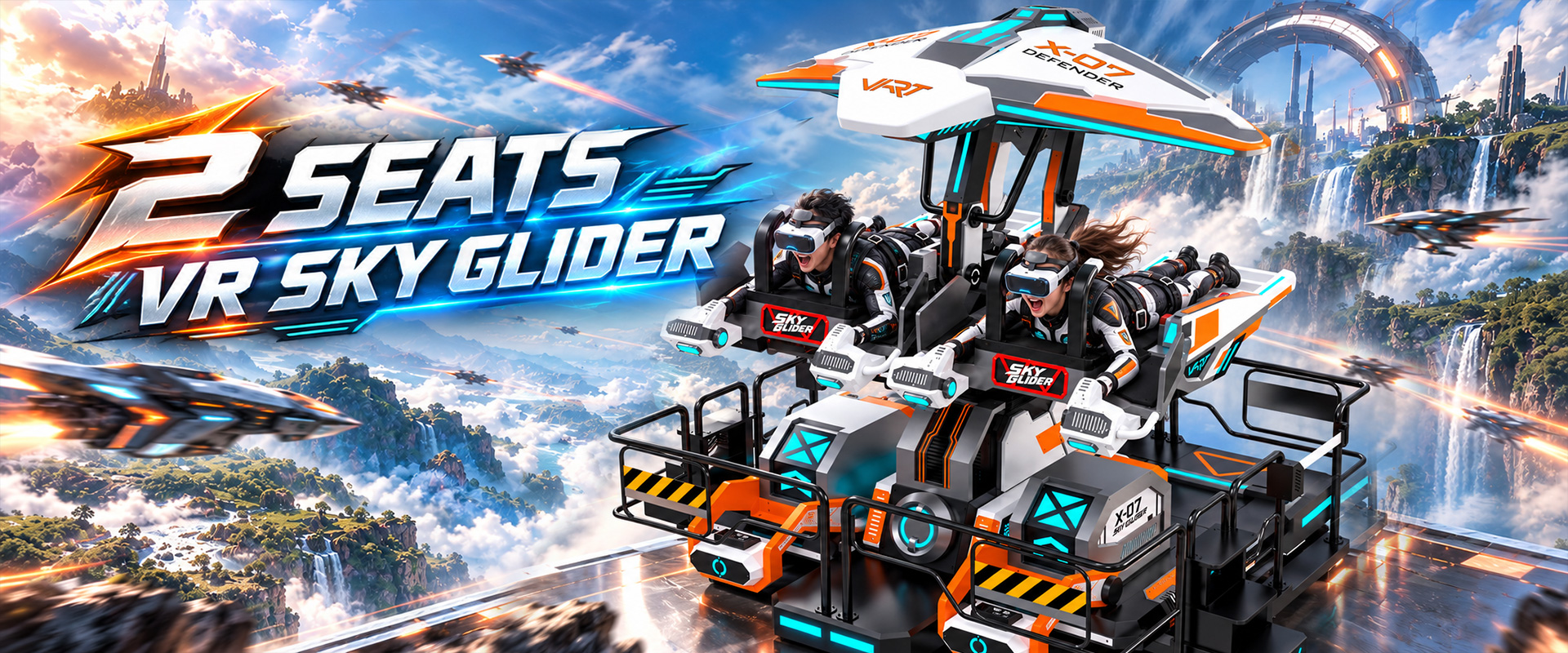
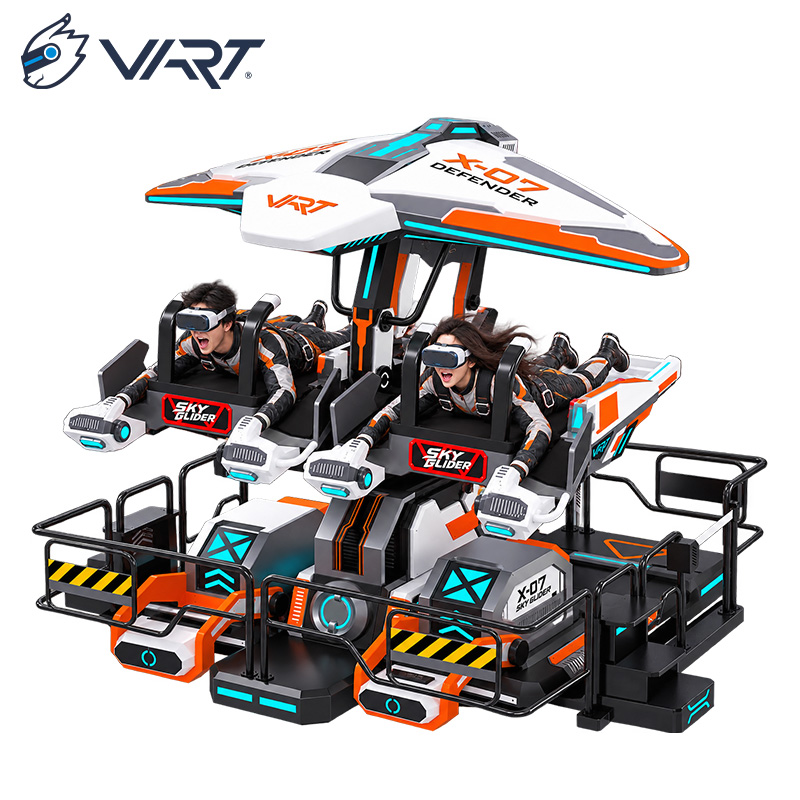
A VR sky glider simulator is a commercial motion ride that places riders in a face-down, prone flight position on a powered platform while a VR headset shows a first-person gliding view. The platform pitches forward and backward, drops vertically, and adds wind and water spray so the body feels what the eyes see. A two-seat unit occupies about 7.5 m² of floor space.
Most VR attractions seat riders upright. The sky glider does not. That single difference — the prone hang-gliding posture — changes both how the ride feels and how it performs commercially, because a machine that looks unusual from across a shopping mall concourse converts passers-by into paying riders. This guide explains the four systems inside the machine, what a ride session actually looks like, and what a venue needs to install one.
VR Sky Glider Simulator at a Glance
| Attribute | Typical Specification (2-Seat Unit) |
|---|---|
| Ride posture | Prone / face-down hang-gliding position |
| Capacity | 2 riders simultaneously |
| Pitch range | 105° front-to-back |
| Vertical drop | 400 mm free-fall travel |
| Environmental effects | Variable-speed air jets, water spray |
| Footprint | 7.5 m² (L 2500 × W 3000 × H 2500 mm) |
| Peak height in motion | 2.9 m at maximum pitch |
| Power | 5.0 kW, 220 V, 50 Hz |
| Machine weight | 950 kg |
| Rider height range | 1.2 m – 1.9 m |
| Session length | 3 – 5 minutes per ride |
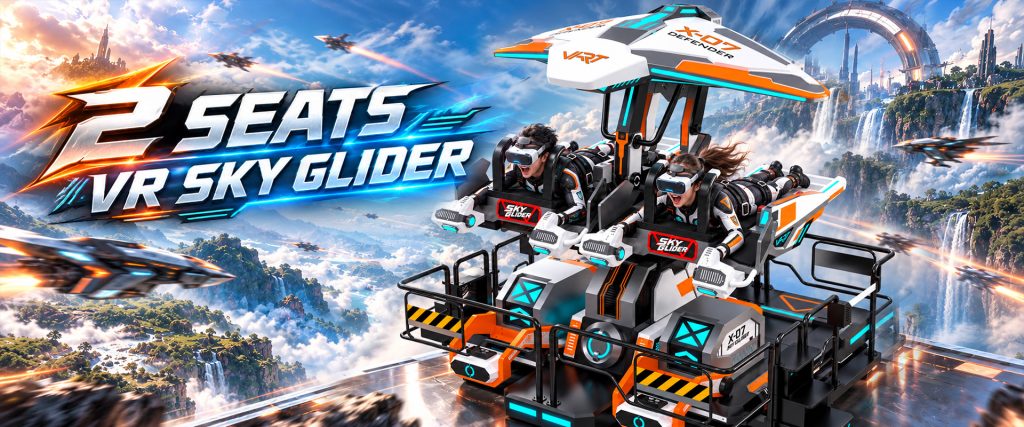
How a VR Sky Glider Simulator Works
The machine is not one device but four subsystems running in sync. When they are aligned to within a few milliseconds, riders stop noticing the hardware and simply feel like they are flying. When they drift out of sync, riders feel motion sickness. Understanding the four layers is the difference between buying a ride and buying a problem.
1. The Motion Platform
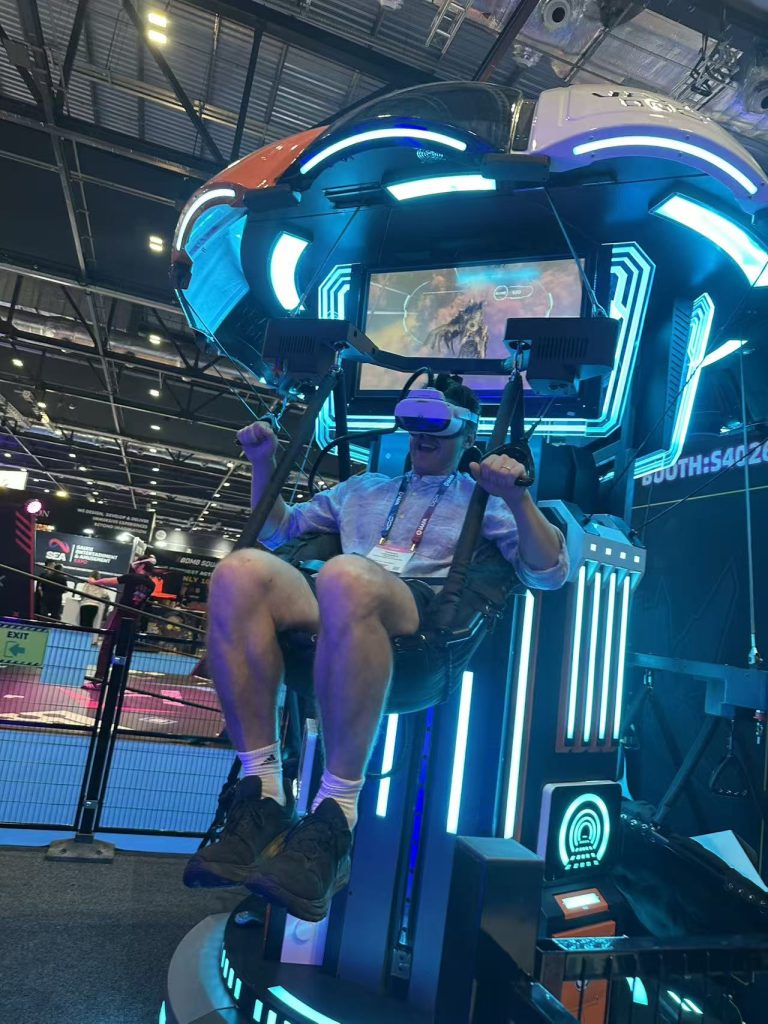
An electric actuator assembly sits under a suspended frame that holds two riders chest-down, arms forward on handgrips. The platform executes two axes of movement:
- Pitch (105°): the frame tilts nose-down and nose-up through a 105-degree arc. Nose-down reproduces a dive; nose-up reproduces a climb or a thermal catch. Because the rider is already horizontal, a nose-down pitch puts the body close to vertical — which is why the sensation is far stronger than the same angle applied to a seated rider.
- Heave (400 mm): the whole frame drops vertically. A fast 400 mm drop unloads the rider’s body weight for a fraction of a second, producing the stomach-lift feeling of losing altitude.
Motion is not random. Each movement is keyed frame-by-frame to the VR content, so the platform starts tilting at the instant the horizon in the headset starts tilting.
2. The VR Headset and Flight Content
Riders wear a standalone headset — commercial units commonly use a customised Pico Neo 3 — loaded with flight content built specifically for the platform’s motion envelope. This matters more than headset resolution. Generic VR flight footage will contain manoeuvres the platform physically cannot perform, and every unmatched manoeuvre is a mismatch between what the inner ear expects and what it receives.
Purpose-built libraries typically include eight or more routes — alpine gliding, canyon runs, low ocean passes — each cut to three to five minutes for throughput reasons explained below.
3. Environmental Effects
Two 4D effects close the sensory loop:
- Air jets: blowers mounted ahead of the riders vary output with the simulated airspeed in the content. Slow thermal circling produces a light breeze; a dive produces a hard rush of air across the face. Variable speed is the important part — constant-speed fans read as a fan, not as flight.
- Water spray: fine mist fires on cue when the flight path passes through cloud or skims a water surface. It is a short burst, not a soaking, and the frequency is adjustable from the control panel for venues where riders arrive in business clothes.
4. The Control and Payment System
Everything above is orchestrated by a backend controller that also handles the commercial side: coin and token acceptance, RFID card readers, and QR-code mobile payment. The same system logs play counts, session times, fault codes and revenue, which lets a venue run the machine unattended and audit it remotely.
What a Ride Session Looks Like
- Payment and selection (20–30 s): the rider pays at the machine and picks a flight route from the screen.
- Loading and restraint (40–60 s): the rider lies chest-down on the pad, feet secured, hands on the grips. An attendant or a self-service prompt confirms the restraint is closed.
- Headset fitting (20 s): the headset is placed and the strap tightened. The platform stays level and locked during this step.
- Flight (3–5 min): launch, climb, glide, dive, and landing sequence, with pitch, drop, wind and spray firing against the content timeline.
- Return and unload (30–40 s): the platform returns to the horizontal loading position and the restraint releases.
Total door-to-door time is roughly five to seven minutes. That arithmetic drives revenue: at a six-minute cycle, one two-seat machine turns over ten cycles per hour, or up to twenty riders per hour at full occupancy. Run your own numbers against local ticket pricing before committing to a floor plan.
How It Differs From Other VR Flight Attractions
| Attraction Type | Rider Posture | Primary Sensation | Visual Draw From Distance |
|---|---|---|---|
| VR sky glider | Prone, suspended | Gliding, diving, weightless drops | Very high — unusual silhouette in motion |
| Seated VR flight simulator | Upright, seated | Banking and turning | Moderate |
| VR parachute simulator | Standing / harnessed | Free-fall then canopy descent | High |
| VR egg chair or motion chair | Seated, enclosed | Vibration and small-angle tilt | Low |
The practical takeaway for operators: seated simulators compete on content variety, while a glider competes on silhouette. Placed in an open concourse where the pitch cycle is visible from thirty metres away, the machine markets itself. Placed in a closed back corner, much of that advantage is lost.
What a Venue Needs to Install One
- Ceiling clearance of at least 3.0 m. The machine stands 2.5 m at rest but reaches 2.9 m at peak pitch, so measuring against the static height is a common and expensive mistake.
- 7.5 m² of floor area, plus a queue and boarding zone in front of the loading side.
- A 220 V / 50 Hz commercial line rated for 5.0 kW.
- A floor able to carry 950 kg plus riders — normally trivial on a ground slab, worth checking on an upper mall level.
- A drainage or mat plan if the water spray will run at high frequency.
If you are scoping a whole venue rather than a single machine, our guide to opening a VR theme park covers layout, staffing and permitting in more detail.
Which Venues Suit a VR Sky Glider
- Shopping malls: the moving silhouette pulls foot traffic from the concourse and extends dwell time.
- Theme parks: adds a flight attraction without the civil works and maintenance load of a physical ride.
- VR arcades and FECs: a high-visibility anchor that lifts revenue per square metre against banks of single-player stations.
- Science museums and tourist sites: the flight theme maps cleanly onto aviation, geography and physics programming.
Frequently Asked Questions
What is a VR sky glider simulator?
It is a commercial VR ride that holds riders in a prone hang-gliding posture on a motion platform. The platform pitches up to 105 degrees and drops 400 mm vertically, synchronised with VR flight content and with wind and water-spray effects.
How long does one ride last?
The flight itself runs three to five minutes. With payment, loading and unloading, plan on five to seven minutes per cycle.
Does a VR sky glider cause motion sickness?
Discomfort in VR rides comes mainly from a mismatch between visual motion and physical motion. Because the platform moves in time with content built for that specific motion envelope, the two signals agree and reported discomfort is low. Sessions are also kept short deliberately.
Can the wind and water effects be turned off?
Yes. Both wind speed and spray frequency are adjustable, and either can be disabled entirely from the backend management dashboard — useful for indoor venues with carpet or for cooler climates.
Who can ride?
Riders between 1.2 m and 1.9 m in height fit the restraint geometry on a standard two-seat unit. As with any motion attraction, venues should post standard restrictions covering pregnancy, back and neck conditions, and heart conditions.
How much floor space and power does it need?
About 7.5 m² of floor area (L 2500 × W 3000 × H 2500 mm), a minimum 3.0 m ceiling, and a 220 V / 50 Hz supply rated for 5.0 kW.
Can the machine be branded for our venue?
OEM and ODM customisation covers logo application and LED colour presets, and 2D/3D venue layout drawings are normally provided before installation.
Next Steps
VART has manufactured VR attraction hardware in Guangzhou since 2011. If you are evaluating a flight attraction for a mall, park or FEC, see the full specification for the 2-Seat VR Sky Glider Simulator, compare it against the rest of our VR flight simulator range, or contact us for current pricing and a free venue layout drawing.